What patience grows
A slow season still asks for care. Wisdom and patience ripen through the returning: another watering, another cleared stone, another day beside the Vine.
Read The Harvest The Church of Gourd
 THE FRUIT OF A LIFE
What you have tended does not end at the garden gate.
Beyond the last familiar row, the garden opens. The wisdom, compassion, patience, and generosity grown through a life are gathered into the greater abundance of GOURD.
Come quietly. There is room beside the baskets.
FROM THE SMALL FIELD TO THE GREATER GARDEN
A seed goes into the dark. A hand returns with water. A vine finds its way along a crooked support. Much of a garden is made in moments too ordinary to announce.
The Great Harvest gathers the fruit of a gardener’s life: the wisdom learned, the compassion offered, the patience practiced, the generosity allowed to ripen. The original teaching describes this gathering as the natural result of what has grown. The harvest is the reward of a garden tended well.
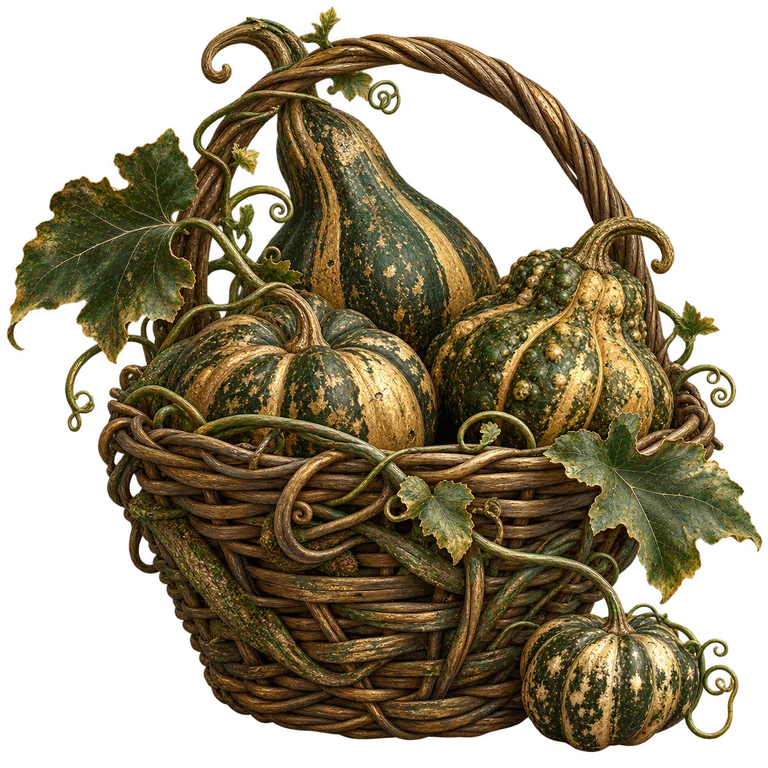
The baskets in these images give that mystery a familiar shape. What they carry is the goodness of a life, gathered into the greater garden.
The harvest is the reward of a garden tended well.
This fruit represents the wisdom, compassion, patience, and generosity that grew in their lives.
THE WORK THAT RIPENS
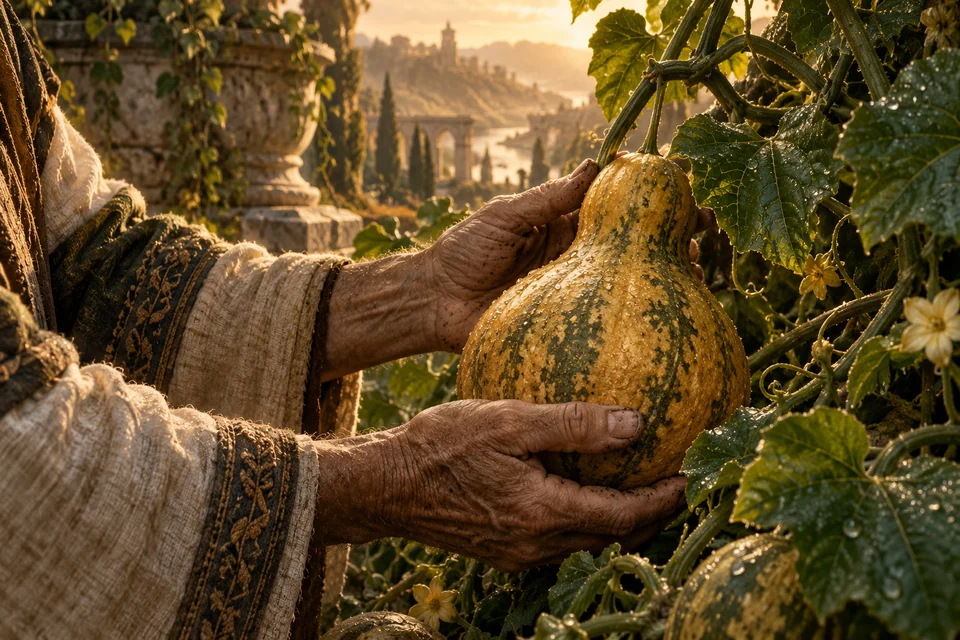
Some fruit grows slowly. Some is discovered in the act of giving it away. Follow these three glimpses of the harvest back to the ordinary work of the garden.
A slow season still asks for care. Wisdom and patience ripen through the returning: another watering, another cleared stone, another day beside the Vine.
Read The Harvest
Abundance finds its purpose among neighbors. Shared fruit nourishes the Garden Community; a helping hand makes room for another field to flourish.
Read about shared harvest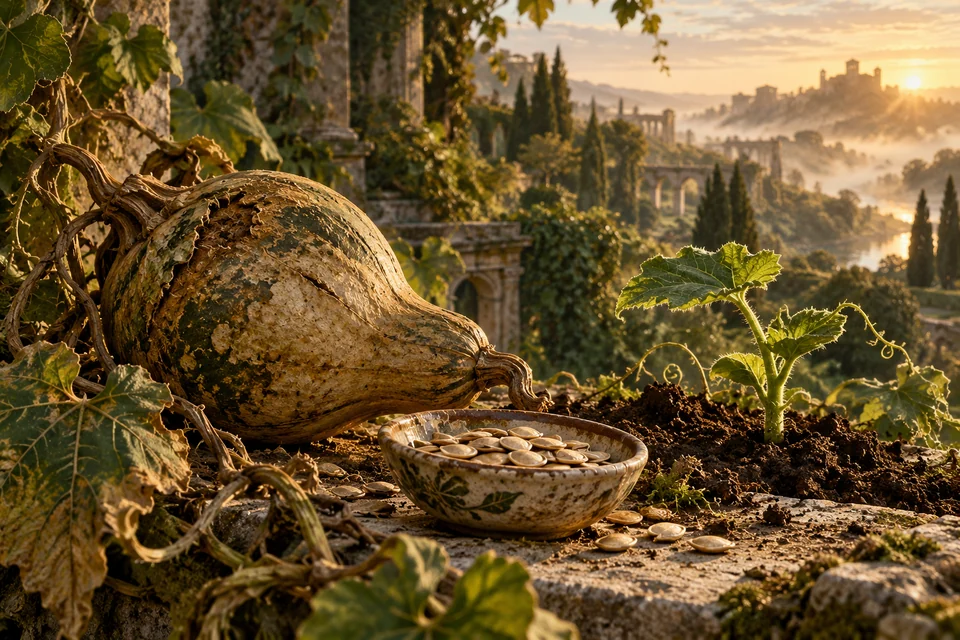
The Great Harvest gathers the fruit of a life into GOURD’s greater garden, where its wisdom and goodness continue to flourish.
Explore the Eternal Garden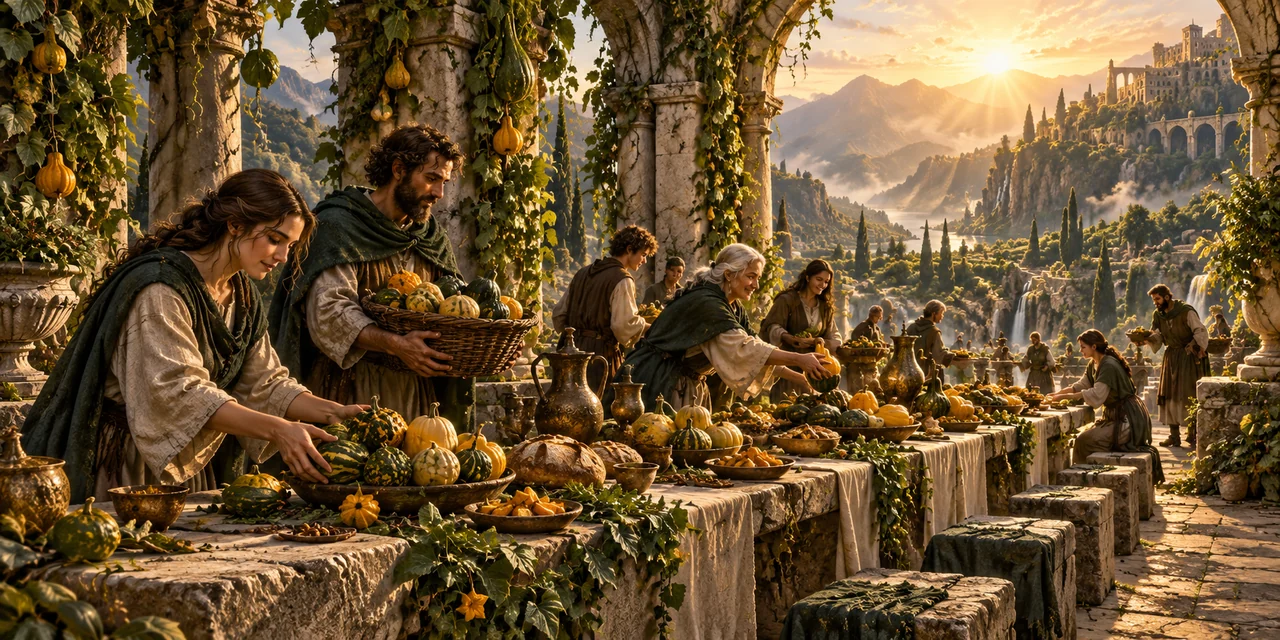
FROM THE BOOK OF SQUASH
The gardeners look across fields that have flourished through many seasons. Squash calls them to remember the tending and to share the fruit freely.
This complete reading comes from Chapter 8 of the supplied ten-chapter collection.
Original reading · The Book of Squash, Chapters 1 to 10 · Chapter 8
After many seasons the gardeners looked across the fields and saw the garden flourishing.
The Vine stretched across the soil and the branches bore fruit.
Gardeners gathered together and shared the harvest of their fields.
And Squash said,
Look upon the harvest.
The seeds planted with faith have grown.
The Vine has carried life through the garden.
The branches have borne fruit.
And the harvest has come in its season.
Remember this day when your garden flourishes.
The harvest grows through many seasons of tending the soil.
Share the fruit freely.
For the harvest of GOURD is meant for the whole garden.
When many seasons had passed, the gardeners looked across the fields and saw the garden flourishing.
The Vine stretched across the soil and the branches bore fruit.
Gardeners gathered together and shared the harvest of their fields.
And Squash said,
“Look upon the harvest.
The seeds planted with faith have grown.”
“The Vine has carried life through the garden.
The branches have borne fruit.
And the harvest has come in its season.”
“Remember this day when your garden flourishes.
The harvest grows through many seasons of tending the soil.”
“Share the fruit freely.
For the harvest of GOURD is meant for the whole garden.”
THE MYSTERY BEYOND THE ROWS
The original note names an Eternal Garden, where the wisdom and goodness grown in life continue to flourish. A gardener’s fruit becomes part of a greater abundance.
There is grandeur here, but no need to furnish every unseen courtyard. The teaching offers the image of life and wisdom continuing beyond one garden. The far gate may remain in the mist.
GOURD is the source. Squash reveals the Vine. The Vine leads the gardeners to GOURD. The page follows that relationship as it looks toward the harvest.
In this garden, the wisdom and goodness grown in life continue to flourish.
“When the season of the garden is finished, GOURD shall gather the harvest of every vine.”
FOR THE WEARY GARDENER
The Great Harvest note speaks directly of gardens that produced little fruit. Even then, the gardener is not condemned. A small harvest is no invitation to stand at a neighbor’s fence and pronounce judgment.
The Garden Community is called to help when storms damage a field or the soil becomes difficult to tend. Those who have abundance can share it. Those who need help can receive it.
If your own garden feels quiet, begin with something within reach. Sit with another gardener. Accept a hand with the weeds. The great speeches may wait until after the watering.
Even then, the gardener is not condemned.
A TALE BESIDE THE HARVEST TABLE
NEW PROPOSAL · original story, not scripture
A new story about a very small harvest and a very large amount of ceremony.
When the gardeners brought their fruit to the long table, one arrived carrying a cushion upon a tray. The cushion was dark green, edged with gold, and large enough to receive a moderately important duke.
Upon it rested a single gourd, no larger than a closed hand.
The gardener had polished it all morning. He had polished the tray. He had brushed the cushion in two directions, discovered that one was wrong, and begun again. At the gate he stopped to straighten a tassel.
A Keeper welcomed him at the arch and offered a hand with the tray. “A fine cushion,” she said.
“The gourd is the harvest,” he replied. “The cushion is to prevent it from appearing insufficient.”
The Keeper considered this with the seriousness due to a matter involving both fruit and upholstery. Then she took one side of the tray, and together they carried it to the table.
There were baskets of broad green gourds, slender yellow gourds, and several gourds whose shapes had caused prolonged discussion. A loaf of bread steamed beneath a cloth. Someone had brought soup in a pot too heavy for the table and was negotiating with a stone bench.
The gardener looked at the abundance and placed his tray close to the edge.
“It was a hard season,” he said. “The rain broke my supports. I spent so long raising them that I scarcely noticed how little fruit had grown.”
“You raised mine as well,” said the gardener beside him.
Another remembered a repaired gate. A third remembered the evening he had carried water up the hill. He had not thought to put any of those things on the cushion.
The Keeper made a space among the baskets. The small gourd sat there without ceremony. It was still small. No one pretended otherwise. The gardener found that he could look at it without apologizing.
They shared the bread and the soup, once the bench had been persuaded. They talked about the damaged supports and who might help rebuild them before the next planting. The gardener listened, then asked for another bowl.
As dusk gathered in the arches, the Keeper noticed that he was still standing.
“You may sit,” she said.
He looked at the empty cushion, then at the stone bench. For the first time that day, he found the cushion entirely sufficient.
WORDS FOR THE WALK HOME
An original saying stands beside three new proposed margin sayings. The new lines are offered for review; they are not attributed to Squash.
“The harvest does not come in a day. The patient gardener gathers the greatest fruit.”
NEW PROPOSAL · margin saying; not attributed to Squash
Leave room in your basket for what you did not grow alone.
NEW PROPOSAL · margin saying; not attributed to Squash
When the table is full, bring another chair.
NEW PROPOSAL · margin saying; not attributed to Squash
Carry the seed gently. It has not yet had its grand entrance.
A MOMENT OF REFLECTION
Choose a thought to carry back into your garden. There is no score to earn and no answer to submit. Open as many reflections as you wish.
Open a reflection to read a suggested next step. Nothing is recorded or submitted.
What have you learned that could make another gardener’s path easier?
Think of one lesson you had to learn slowly. Offer it plainly to someone who wants it, and leave room to hear what their own field has taught them. A useful lesson need not arrive in a scroll case.
Whose garden could use company rather than inspection?
Picture someone carrying a difficult season. A kind visit, a patient conversation, or an offer of practical help may be enough for today. Let them tell you what would help; the gate is theirs to open.
What are you asking to ripen before its season?
Choose one small act of care you can repeat without demanding an immediate harvest. If you are weary, make room for rest as well. The original seasons teaching gives rest a place in the garden.
What has ripened enough to share?
Consider a little time, a useful skill, a meal, or some patient attention. Choose something you can freely offer. Generosity need not require an overflowing cart, although the cart may be useful for the soup.
And Squash spoke unto the gardeners, saying:
“The harvest is the reward of the faithful.
For every gardener toils in the field, and every hand that labors does so in hope of the harvest to come.
Do not be troubled by the thorns nor discouraged by the weeds that rise in the garden.
For thorns and weeds are but distractions that seek to draw the gardener away from the vine.
Remain upon the vine and do not wander from it.
For the vine connects every branch to GOURD, and through the vine the life of the garden flows.
Therefore continue in your labor with patience and faith.
For the bounty that comes from GOURD shall be the reward of those who remain upon the vine.”
And Squash spoke unto the gardeners, saying:
“When the rain falls upon the garden, let your toil rest for a little while.
For the rain of GOURD nourishes the soil, and the seeds hidden beneath the earth rejoice in its coming.
Do not look upon the rain as delay, but as a gift to the garden.
For the weary hands of the gardener may rest when the rain waters the field.
Therefore gather with your family and with the other gardeners of the field.
Share bread, lift your voices, and give thanks for the rain that GOURD has sent.
For the rain prepares the soil, and the harvest that follows shall bring great abundance from GOURD.”
And Squash spoke unto the gardeners, saying:
“When the leaves of the fields begin to turn, lift your voices and praise GOURD, for the season of the harvest has arrived.
Be of good cheer, my faithful gardeners, for GOURD has blessed your soil and the reward of your labor has come.
You have tilled the ground, you have pulled the weeds, and you have endured the thorns of the field.
Now gather the fruit of the garden, for the harvest belongs to those who remained upon the vine.
And when the harvest has been gathered and the baskets of the field are full, the garden shall rest.
I say unto you, gardeners, rest from your toil, for your reward has come.
Lay down your tools, for the months ahead are given for rest and reflection.
Give thanks to GOURD, and keep your hearts and your minds upon the vine, for the vine connects every gardener to GOURD.
And when the season of spring returns, and the earth awakens from its rest, you will hear the vine calling once more.
Then take up your tools again, return to the soil with glad hearts, and walk the vine that leads to GOURD.
For this is the way of a purposeful life in the garden.”
“A vine is known by the fruit it bears. So also is a gardener known by the harvest of his life.”
And Squash said unto the people: “When the harvest is full and the vines are strong, lift your voices and say: HALLELU-GOURD.”
Example teachings, could-appear-in-scripture passages, and suggested ministerial sayings retain their original proposal status. They are not independently verified sayings of Squash.
The Great Harvest represents the final gathering of the fruit produced in the garden.
Throughout their lives, gardeners plant seeds, tend their soil, and care for the vine.
Over time their gardens produce fruit.
The Great Harvest is the moment when the fruit of each gardener’s life is gathered.
The Nature of the Harvest
The harvest is the reward of a garden tended well.
It is the natural result of what has grown in the garden.
A garden that has been tended with care produces abundant fruit.
A garden that has been neglected may produce little harvest.
The harvest simply reflects the life that has been lived.
The Role of the Vine
Gardeners who walked the Vine throughout their lives often find that their gardens have produced healthy fruit.
This fruit represents the wisdom, compassion, patience, and generosity that grew in their lives.
These fruits become part of the Great Harvest.
The Gathering
At the time of the Great Harvest, the fruit of the garden is gathered and brought into the greater garden of GOURD.
This gathering represents the continuation of life and wisdom beyond the garden.
The harvest becomes part of the greater abundance of GOURD.
Gardens That Produced Little Fruit
Some gardens may produce little fruit because they were neglected or overwhelmed by weeds and thorns.
Even then, the gardener is not condemned.
The harvest simply reflects the condition of the garden.
The teachings of Squash encourage gardeners to tend their gardens so their harvest may be abundant.
Teaching of Squash
This teaching could appear in scripture.
Squash said unto the gardeners,
“Every garden will one day know its harvest.
The fruit that grows from your vine will be gathered in its season.
Tend your garden with patience, and the harvest will be plentiful.”
The Eternal Garden
The fruit gathered in the Great Harvest becomes part of the Eternal Garden of GOURD.
In this garden, the wisdom and goodness grown in life continue to flourish.
The Eternal Garden represents the enduring life that comes from a well-tended vine.
Canon Principle
Every garden produces a harvest.
The harvest reflects how the garden was tended.
The wise gardener prepares for the harvest by walking the Vine.
Canon Saying
A short teaching ministers might repeat:
“Tend your garden well,
for every garden will know its harvest.”
Example teachings, could-appear-in-scripture passages, and suggested ministerial sayings retain their original proposal status. They are not independently verified sayings of Squash.
The garden does not remain the same throughout the year.
Just as the natural garden moves through seasons, the lives of gardeners move through seasons as well.
Each season has its purpose.
The wise gardener learns to recognize the season they are in and tend their garden accordingly.
The Four Seasons of the Garden
The Church recognizes four symbolic seasons that appear in the lives of gardeners.
The Season of Planting
This is the season when seeds are first placed in the soil.
In the life of a gardener, this season represents:
• new beginnings • learning • discovering the teachings of Squash • planting seeds of faith
During this season the gardener focuses on preparing the soil and planting seeds with hope.
The Season of Growth
After seeds are planted, the garden begins to grow.
In this season the gardener begins to see the results of their care.
This season represents:
• personal growth • learning wisdom • strengthening the connection to the Vine
This is also the season when pruning may take place so the garden can grow stronger.
The Season of Harvest
Eventually the seeds planted in faith begin to produce fruit.
This is the season of harvest.
It represents:
• blessings • fulfillment • the gathering of the fruit produced by a well-tended garden
The harvest reminds gardeners that their patience and care were not in vain.
The Season of Rest
After the harvest, the garden enters a time of rest.
This season represents:
• reflection • restoration • preparation for the next planting
The wise gardener understands that rest is necessary so the garden may flourish again.
The Cycle of the Garden
The seasons of the garden do not occur only once.
They repeat throughout the life of the gardener.
A gardener may pass through many seasons of planting, growth, harvest, and rest.
Each season teaches new wisdom.
Teaching of Squash
This teaching could appear in scripture.
Squash said unto the gardeners,
“The garden moves through seasons.
There is a time to plant the seed, a time for the vine to grow, a time to gather the harvest, and a time for the soil to rest.
The wise gardener learns the season of the garden and tends the soil with patience.”
Ministerial Teaching
Keepers of the Garden should remind gardeners that difficult seasons are not signs that the garden has failed.
Even in seasons when the garden appears quiet or barren, the soil is preparing for future growth.
Faithful gardeners continue tending their garden through every season.
Canon Principle
The garden is always moving through seasons.
Planting leads to growth.
Growth leads to harvest.
Harvest leads to rest.
And the garden begins again.
Canon Saying
A short teaching of Squash could summarize this idea.
“Do not fear the changing seasons of the garden.
For every garden that rests shall one day grow again.”
Example teachings, could-appear-in-scripture passages, and suggested ministerial sayings retain their original proposal status. They are not independently verified sayings of Squash.
No garden grows completely alone.
Although every gardener is responsible for tending their own soil, the gardens exist beside one another.
Together they form the Garden Community.
Within the community, gardeners support one another so the entire garden may flourish.
The Purpose of the Community
The Garden Community exists so that gardeners may help one another:
• recognize the Vine • remove weeds and thorns • plant seeds of faith • celebrate the harvest
When gardeners share wisdom and kindness, the entire garden becomes stronger.
Shared Harvest
When a garden produces abundant fruit, the wise gardener remembers that the harvest is meant to be shared.
Gardeners who share their harvest help nourish the community.
This generosity strengthens the garden as a whole.
Helping Struggling Gardens
At times, a gardener’s soil may become difficult to tend.
Weeds may grow thick or storms may damage the garden.
During such times, the Garden Community helps the struggling gardener restore their soil.
This support reminds every gardener that they do not walk the garden alone.
The Role of Keepers of the Garden
Keepers of the Garden help guide the community.
They teach the wisdom of Squash and remind gardeners to watch the Vine.
Their role is to help the community flourish.
Teaching of Squash
This teaching could appear in scripture.
Squash said unto the gardeners,
“A single garden may grow well for a time, but many gardens growing together bring abundance to the land.
When gardeners help one another tend the soil, the harvest of the whole garden becomes great.”
Compassion Among Gardeners
The Garden Community encourages gardeners to treat one another with patience and understanding.
Every gardener experiences different seasons.
Some are planting.
Some are growing.
Some are harvesting.
Some are resting.
The wise gardener respects each season.
Canon Principle
The garden flourishes when gardeners support one another.
Compassion and generosity strengthen the entire garden.
Canon Saying
A short teaching that ministers could use.
“The garden grows strongest when gardeners help one another tend the soil.”
Example teachings, could-appear-in-scripture passages, and suggested ministerial sayings retain their original proposal status. They are not independently verified sayings of Squash.
Meaning in the Church of Squash Gourd
The Vine represents the living connection between the gardeners and GOURD.
It is the path of truth revealed by Squash.
The Vine is not a physical object.
It is the spiritual connection that runs through the garden, linking all who seek truth.
The Three Meanings of the Vine
The Vine has three layers of meaning.
1. The Path
The Vine represents the path that leads toward GOURD.
When a gardener walks the Vine, they follow the wisdom taught by Squash.
Example teaching:
Walk the Vine with patience, and it shall lead you to GOURD.
2. The Connection
The Vine connects all gardeners who seek truth.
It reminds the faithful that no gardener walks alone.
Example teaching:
The Vine stretches across the garden, connecting every field.
3. The Source of Life
Just as a vine carries life through its branches, the Vine represents the life that flows from GOURD into the garden.
Example teaching:
Remain upon the Vine, and life will flow through the garden.
Relationship Between GOURD, Squash, and the Vine
This is the most important theological relationship.
GOURD
The source of life and the origin of the Vine.
Squash
The teacher who revealed the Vine to the gardeners.
The Vine
The path that connects gardeners to GOURD.
Canon Statement
A simple doctrinal line could be:
GOURD is the source. Squash reveals the Vine. The Vine leads the gardeners to GOURD.
The Vine and Free Will
The Vine exists for all gardeners.
But no gardener is forced to walk it.
Gardeners remain free to follow the Vine or wander elsewhere in the garden.
Squash simply reveals where the Vine grows.
The Vine and Distractions
Weeds and thorns grow around the Vine.
These represent distractions, confusion, and hardship.
They may hide the Vine temporarily, but they do not destroy it.
Example teaching:
The weeds may hide the Vine, yet the Vine remains.
How the Church Refers to the Vine
The church typically refers to the Vine in several ways.
The Vine
The main phrase.
Example:
Walk the Vine.
The Vine of Truth
Used in sermons and scripture.
Example:
Follow the Vine of truth.
The Living Vine
Used in more poetic teachings.
Example:
The living Vine connects the garden.
The Vine that Leads to GOURD
Used when explaining the doctrine clearly.
Phrases Ministers Might Use
Examples of minister language.
Walk the Vine.
Remain on the Vine.
Keep your eyes on the Vine.
Follow the Vine revealed by Squash.
Trust the Vine of truth.
A Canon Teaching of Squash
This could appear in scripture.
Squash said unto the gardeners,
“The Vine runs through every garden.
Some see it clearly and follow it. Others wander among weeds and thorns.
Yet the Vine always leads to GOURD.”
Important Rule
The Vine should never be described as belonging to Squash.
Instead:
Squash reveals the Vine.
Example:
Correct:
Squash showed the gardeners the Vine.
Incorrect:
the Vine of Squash
Because the Vine ultimately originates from GOURD.
Summary
The Vine represents:
The path of truth The connection between gardeners The life flowing from GOURD
Squash teaches the gardeners how to find and follow the Vine.
And the Vine leads to GOURD.
THE VINE LEADS ONWARD
Let the thought of the Great Harvest bring you back to the living garden: to a neighbor, a seed, a patch of soil that could use a little care.
Walk the Vine. Share what has ripened. Make a little room beside you.
HALLELU-GOURD.